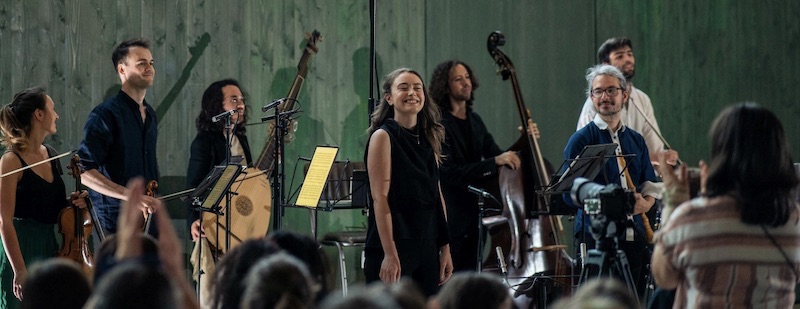
 THE impact of Martin Luther on the history of Christianity and Western Europe is huge and well-known. Perhaps slightly less familiar is his importance as a composer of religious music, sacred hymns and settings of biblical texts. One of the best-known of these is Christ lag in Todesbanden (Christ lay in death’s bonds) and this was the text that inspired a glorious and unusual concert by the Parnassus Ensemble at Wareham’s Lady St Mary Church, on the second day of this year’s Purbeck Art Weeks.
On a baking evening, when children were still happily swimming in the River Frome, the church was a cool space for the performance by this young group of musicians and singers, directed by Oscar Holch.
The text, an Easter hymn by Luther, who co-wrote the melody with Johann Walter, dates from 1524, but draws heavily on a 12th-century Latin sequence, Victimae paschali laudes. It has been set by several composers, most notably Bach, but also Pachelbel, Telemann and Kuhnau. The concert featured three of these settings, chronologically, by Pachelbel, Kuhnau and Bach.
The director opened the evening by explaining that the ensemble is dedicated to historically informed performance, “trying to involve the audience in the mindset of the artist of the time.”
With his vernacular German translation, Luther had aimed to bring the Bible much closer to ordinary people and to their everyday lives. The power of his words is shown so clearly in Christ lag in Todesbanden. It is an Easter chorale, but a work that speaks of hope and the triumph of life over death, not only in Luther’s time – when persecution and execution were the fate of many Catholics and Protestants during the turmoil of the Reformation – but also in our troubled times.
The three composers bring very different style and sensibility to the hymn – it was one of Pachelbel’s last works, moving but very much a work of the late medieval/early baroque period. Kuhnau’s setting is accessible, exciting, with down-to-earth phrasing and great energy. Both composers stand on the edge of change – Pachelbel at the end of a long stable period of music, Kuhnau almost experimental, and Bach heralding the arrival of a new style of music. A revolution in music, spanning just 50 years, that partly reflects the dramatic change in the religious life of Germany.
The great Bach cantata is a work that is profoundly spiritual, serious and uplifting, but also highly theatrical. It requires great virtuosity and energy from the performers, who rose magnificently to its demands and challenges.
Alongside the music, the audience had a sheet with poems selected by the ensemble to inspire reflections on Luther’s text. The poets chosen spanned seven centuries, from the 13th century Persian poet Rumi, via John Donne (Death, be not proud) and William Blake (The Tyger) to Shelley’s meditation on the transience of human power (Ozymandias). Two 20th century poems were Wendell Berry’s thought-provoking Original Sin, and TS Eliot’s Ash Wednesday, with its brilliant play on words (word-world-whirled).
An unusual additional element of the concert was the presence of three large white screens, behind the performers. Here, artist Jeremie Queyras painted as the music unfolded, using bold primary colours in big strokes to produce three loosely connected abstract paintings. The painter clearly responded to the movement and emotion of the music – it was interesting to watch, but not everyone in the audience could see a relationship between the paintings and the music.
But whether or not they liked the paintings, the audience was unanimous in their enjoyment of the music. Several people said they hoped the Ensemble would come back to the festival again – PAW has quite a record of inviting popular performers back, so let’s hope that Parnassus can follow the success of I Fagiolini who have appeared many times, and this year opened the festival with a concert in which they looked back on their 40 years of music-making.
Parnassus have only been in existence for about four years, but this outstanding group of singers – Sam Cobb, Lorna Price, Jonathan Hanley and Filippo Turkhiemer – and musicians, Xenia Gogu, Edith Kotler, Anne Sophie van Riel, Ana Dunne Sequi, Victor Garcia Garcia, Gabriele Basilico and Xiaowen Shang – are all names to watch. FC
• Purbeck Art Weeks, which runs to 7th June, includes open studios, gallery events, exhibitions and workshops. The programme of live music includes Grace Newcombe, Liana Sadler and Colin Heller performing Chalk: Songs for the South West, on Friday 29th May at Sandy Hill, Wareham; Fieri Consort at the Church of Lady St Mary on Saturday 30th; Grace Newcombe and Elizabeth Sommers, with Alysoun: Songs from the people of 13th century Britain, at St Peter’s Church, Church Knowle, on Sunday 31st; The Whispering Dome at Swanage’s Mowlem Theatre on Friday 5th June; and Waft Her, Angels, Through the Skies, Handel arias by Guy Cutting at St James Church, Kingston, on Saturday 6th.