 YEARS ago, when the Bible, including the often gruesome Old Testament stories, were part of the curriculum, most of us knew a bit about the more colourful characters – Abraham, King David, Daniel (with all his torments), Judith (murdering the enemy general Holofernes), Jonah (in the whale), Noah (and all those pairs of creatures) … and Samson, superhumanly strong but fatally flawed by his love (lust) for the wicked seductress Delilah.
 Nowadays Delilah is probably best known as the notorious inspiration for one of Sir Tom Jones’s biggest hits back in 1968! So there may have been some in the audience for Dorset Opera Festival’s production of Saint-Saens’ best-known opera, Samson et Dalila, who didn’t know the original story.
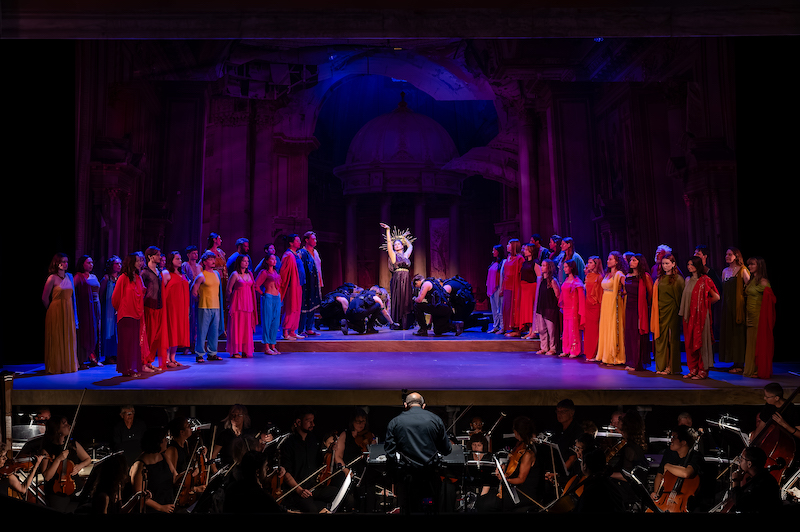
In Paul Carr’s lucid, sensual and darkly emotional production, the story is very powerfully told. The setting is a Middle Eastern country where the Israelites are kept in bondage and slavery by the cruel and decadent Philistines (it is an interesting reflection on how words change their meaning that nowadays a Philistine is a person with no cultural, artistic or literary interests). Designer Rufus Martin has created a timeless setting, appropriate given the tragic historic fact that at no point in the long history of this region – often called the birthplace of civilisation – have there been any lengthy periods of peaceful coexistence.
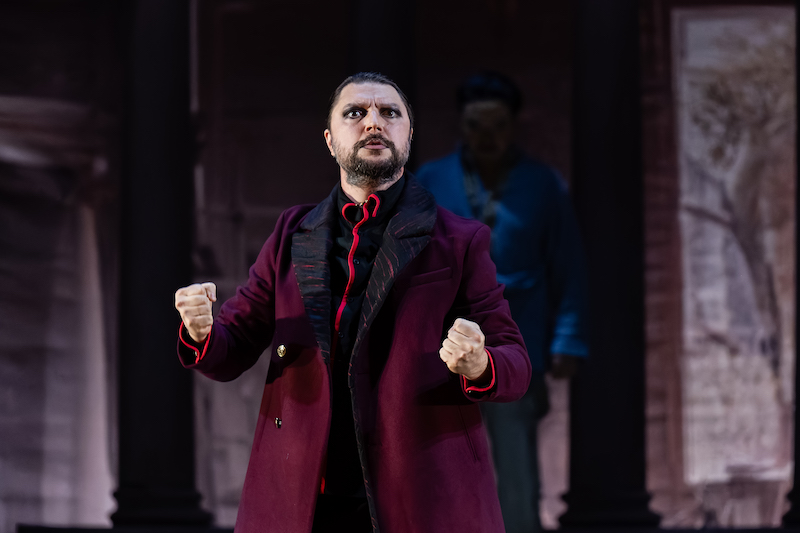
 The curtain rises on the desperate and depressed Israelites, bewailing their miserable existence and calling hopelessly on their god to rescue them. The scene is electrified by the arrival of Samson (the powerful and charismatic Won Who Choi, making a stunning UK debut), who energises and encourages them and kills the arrogant, taunting Philistine governor Abimelech (Jonathan Eyers, who deserves a more impressive costume that would flatter his elegant height). Aiden Smith makes the most of his Spiritual Elder moment, his resonant bass underlining advice that will not be taken.
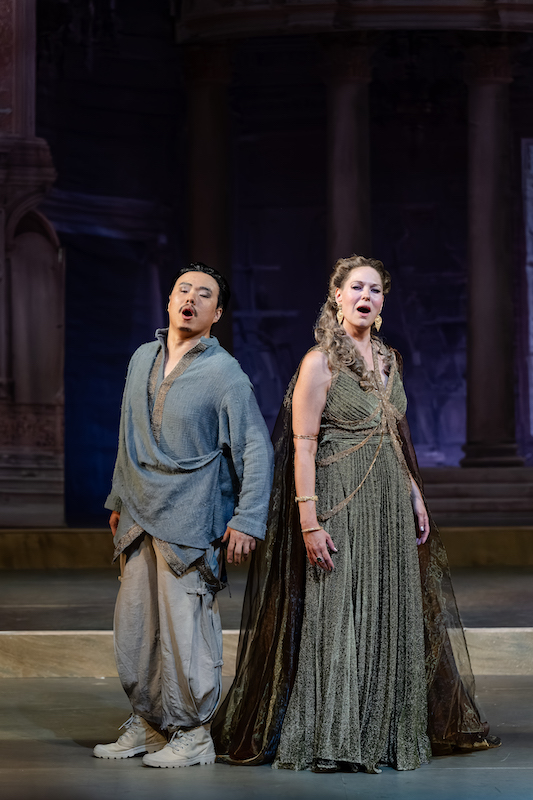
Dalila (Mae Heydorn) is a voluptuous seductress, whose sinuous charms disguise the cold hatred she feels for Samson, who has led the despised Israelites in a successful uprising and humiliated her people. Encouraged by the evil high priest of Dagon (Alexey Gusev, a thrilling baritone), Dalila is preparing to draw Samson into her sensual web, manipulating and beguiling him into revealing the source of his huge strength.
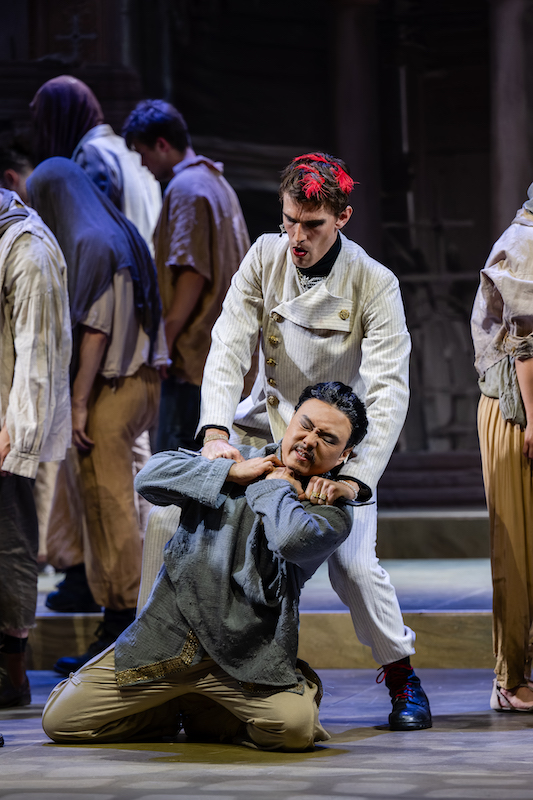 While there are huge Israelite and Philistine chorus scenes – and I have never heard the Dorset Opera chorus in better or more powerful voice – and some effective, if rather overheated, thuggery from the high priest’s leather-strapped guards, this opera is all about the title characters. Their performances are simply breathtaking.
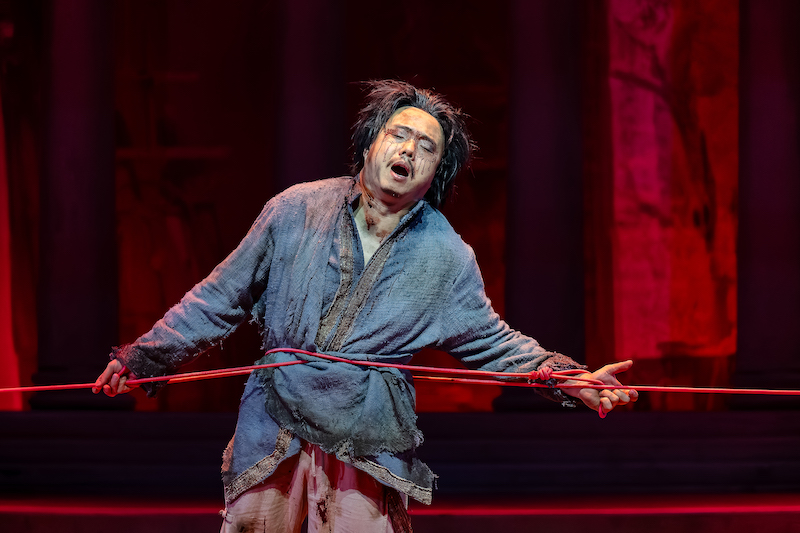
Korean tenor Won Who Choi has already made his mark in leading opera houses around the world, including as Tamino, Rodolfo and Alfredo, but Samson is very different from these romantic roles. This is a deeply flawed hero, whose self-knowledge of his weakness in the face of Dalila’s irresistible allure gives him a tragic status. It requires a singer who acts with deep conviction, able to portray god-given strength, lust-driven physical and moral collapse, and final tortured but victorious nobility. There was no moment in Won Who Choi’s performance when we were not utterly convinced.
Mezzo soprano Mae Heydorn embodies the legendary, sensual temptress, with movements that are sinuous and bewitching in the truest sense of the word, and a voice that can melt gold and freeze to the bone. In terms of both acting and singing it is a massive and demanding role – as is Samson – and Heydorn is as captivating as she is chilling.
 The one point in the emotional turmoil of the final act, where the sure-footed director seems to have temporarily lost his grip, is in the famous Bacchanale. This needs to be more robustly decadent – it’s all there in the driving and accelerating rhythms of Saint-Saens’ music, and this is a chorus that clearly responds to that drive. The movement is too tame – we need to see the unleashed religious frenzy of the followers of the blood-hungry god.
The finale is remarkably effective – from the child who guides the blinded, tortured Samson towards the great pillars to the carnage of the collapsing temple, the famous scene is powerfully led from the orchestra pit, where the excellent festival orchestra is ably conducted by Jeremy Carnell.
This is a triumph for Dorset Opera Festival – and there are still a few tickets left for the final performance, at the matinee on Saturday 25th July.
FC
Photographs by Julian Guidera