 SHIRLEY Jackson’s book The Haunting of Hill House, published in 1959, has been described as the greatest horror story ever, so it’s no surprise it has seen several stage and two screen adaptations.
Now the book has been adapted by Stef Smith, for a new theatrical version, designed by Ti Green and directed by Martin Constantine for Wiltshire Creative and Theatre Clwyd. It opened at Salisbury Playhouse in September before a six-venue tour of the UK.
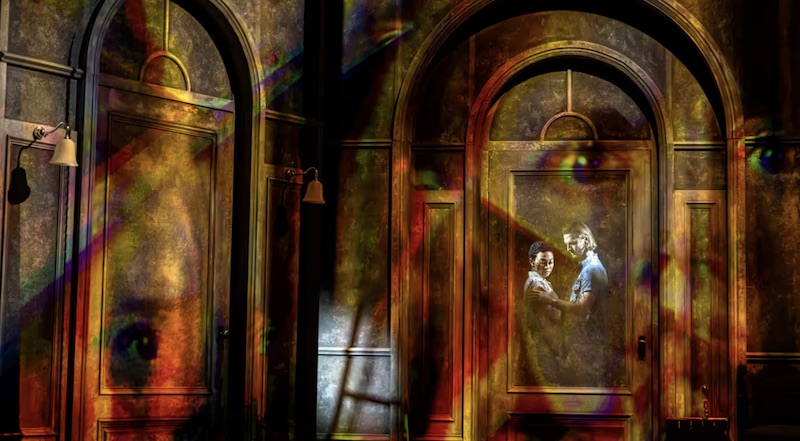
The eager audience awaiting the curtain was brought to attention by a plunge into darkness and a very loud bang, and from that moment the tension built throughout the mysterious and shape-shifting Hill House, miles from its nearest neighbour and designed for twists and turning and doors and corridors. These effects, with projections, moving curtains, shadows and lighting, are brilliantly created by Ti Green, and they never lose their impact as the story unfolds.
Oddly, although the book has been around since the late 1950s, its references seem strangely familiar from horror and mystery stories that succeeded it. Clever that … immediately challenging the chronology of our own memories. Don’t we already know something about rocking horses that rock on their own (The Woman in Black, 1983) – about musical boxes that don’t, and then do, play music (Henry James, 1898)– about abandoned children’s nurseries?
This is the story of Dr Montague, a scientist whose speciality is research into the psychic. He has asked two women, the sophisticated Theodora and the recently bereaved Eleanor, to join him in the reputedly haunted Hill House, along with Luke, the heir to the property. Together they will spend a month trying to capture the sounds and images of the haunters with the help of “modern” equipment. But each of them has a not-too-well-hidden agenda, and those agendas link up with the legends that surround the menacing house.
Mrs Dudley is the taciturn but determined housekeeper, and she will neither stay in the house overnight not open the curtained door to the tower. Then Dr Montague’s traditional Arcati-style medium wife arrives. In the book she is introduced for comedic effect, along with a bombastic schoolmaster who is missing from this adaptation.
Before a horror play can be successful on stage it is essential that the actors play it for real. It’s a joy to see Jasper Britton back on stage at the Playhouse, here as the irascible Dr Montague. Clancy Ryan builds up extraordinary tension as the confused Eleanor. Sophie Lenglinger’s Theodora has a tangible sexual charisma, directed at both Eleanor and the louche Luke (Robin Morrissey).
The soundscape is suitably unsettling, timed to perfect jump-out-of-your-seat surprise. As the nasty end moves inexorably nearer, the audience members grip tighter to the arms and move further to the edges of those seats. The sets and costumes are marvellously effective, and will test the technical abilities of every individual theatre. Many eyes are tightly shut, just as they should be for this sort of show.
Am I someone who avoids horror movies after a still-vivid childhood cinema experience? – Yes I am. Was I scared? Well, no.
GP-W