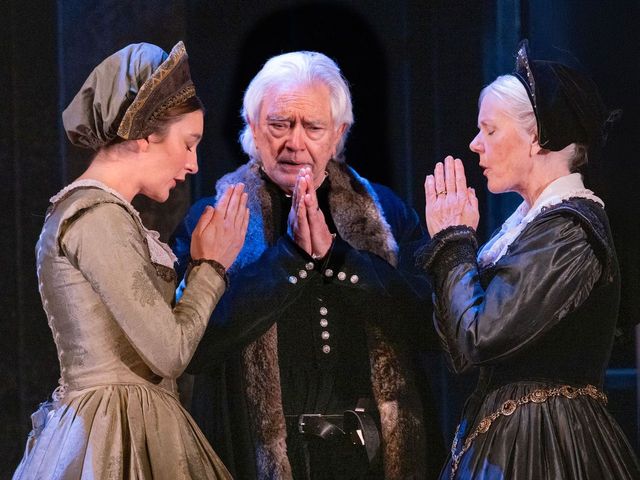
 WE live in a selfish era, when it is difficult to persuade someone to become an officer of a society unless there is a large honorarium on offer. If you go back a couple of generations, especially in a small community, you would find people only to happy to take up such posts.
I once heard such a person, the most honest and generous with their time and personal support I have ever encountered, described as “honest to the point of stupidity”. And that phrase could well be applied, if we are to believe playwright Robert Bolt’s beautifully written play, to Henry VIII’s Lord Chancellor Sir Thomas Moore.
He was a man with such great principles that he would rather face disgrace and execution than go against those principles and declare that Henry had the right to divorce Catherine of Aragon, leaving the way open for him to marry Anne Bolelyn. At a time when the Tudor court was a hotbed of intrigue and plotting, it is not surprising that such a man was envied by many, even his enemies, and feared by others because of his incorruptibility.
And when he gave up his powerful office rather than acknowledge Henry VIII rather than the Pope, to be head of the newly established Church of England. Hoping for a peaceful retirement as a poor country squire, it did not dawn on him that those opposed to the King’s reforms would see him as a rallying point, and therefore a threat to them and their ambitions.
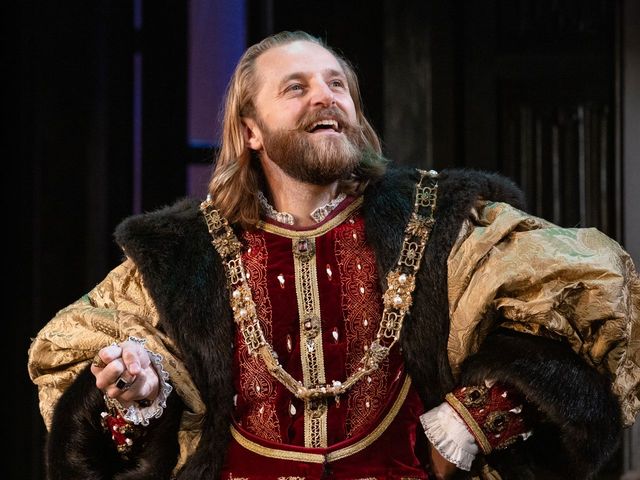 Moore is a colourless academic lawyer compared to the characters around him – his principal antagonist the morally corrupt Thomas Cromwell (played by Sam Phillips), the ambitious Richard Rich, (Peter Losasso), prepared to commit perjury for political advancement, the ailing previous Lord Chancellor Cardinal Wolsey (Nicholas Day), the great survivor Thomas Howard, Earl of Norfolk, friend of Moore’s but prepared to run with the hare and hunt with the hounds, the once athletic King Henry, (Orlando James) now showing signs of the illnesses that will prevent him siring more than one weak male heir to the throne, and Paul Kemp’s wonderfully flamboyant Common Man, drawing all the threads of the story together as narrator as he reminds us of the fate awaiting most of those characters, a faithful servant to the Moore household, and half dozen other characters including the executioner.
Amongst the machinations of this group and the more outgoing personalities of Moore’s sharp tongued wife Alice (Polly Kemp), loving daughter Margaret (Grace Molony), and her religiously feet -of-clay, fiery tempered husband William Roper (Hew Brentnall), it would be easy for Sir Thomas to blend seamlessly with Simon Higlett’s dark brooding sets, and it takes real subtlety of acting, with only a few broad gestures and full throttle vocal deliveries to create, as Martin Shaw did, a Sir Thomas Moore who dominated scene after scene.
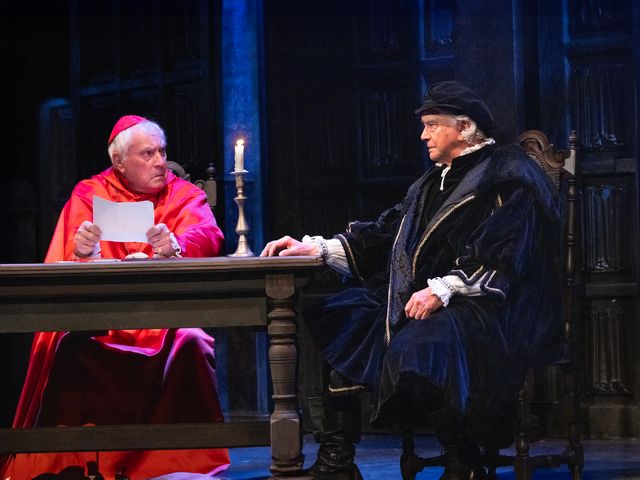 Like Shaw, director Jonathan Church realised that the last thing Robert Bolt’s superbly written text required was being hit hard and underlined in thick indelible pencil. As you would expect from a former Millfield School history teacher, and the winner of two Academy Awards for best screenplay adaptions of Dr Zhivago and A Man for All Seasons, Bolt uses words to paint pictures as beautiful as any French Impressionist artist, and this production allows you to see and hear those words in their full glory.
GRP
Photographs by Simon Annand