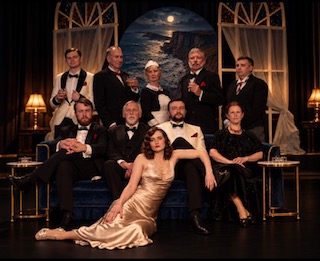
 Ten little soldier boys went out to dine,
One choked his little self and then there were nine …
There are many versions of this rhyme, some now consigned to history because of their racist connotations, but the theme is always the same – you start off with ten and you end with none.
How you get there is the fascination and nobody did it better, or with more tension and drama, than Agatha Christie. Director Sophie Ruel has always wanted to direct an Agatha Christie mystery and, with this year marking the 50th anniversary of the death of the Queen of Crime, what better opportunity?
The curtain rises on the lounge and bar area of a seaside hotel where a middle-aged couple, in bar manager and waitress dress, Mr and Mrs Rodgers, are preparing for a house party. Fairly rapidly we realise it is on an island, and only reached by boat. Gradually the guests arrive.
We soon discover they do not know each other, they do not know why they have been invited – and none of them actually knows the hosts, Mr and Mrs Owens.
The guests are a random bunch – Mrs Owens’ new secretary, Vera Claythorne (who has not yet met her employer), speed-mad man-about-town Anthony Marston, ultra-religious Emily Brent, former soldier Captain Philip Lombard, aged widower General John MacKenzie, the somewhat mysterious Mr Davis/Mr Blore, successful Doctor Armstrong and retired Judge Sir Lawrence Wargrave.
The guests are surprised to hear that their hosts have been delayed and will not be joining them until the following day. So they settle into an evening of drinking and slightly spiky conversation. Then Rodgers puts a record on the gramophone … and the scene gets much darker.
The director has assembled a talented cast to portray the diverse, clashing and possibly murderous guests and staff, led by the experienced and versatile Jerome Swan as the judge, the voice of calm and intelligence in the increasingly terrified party, and Rosie Mills in the demanding role of Vera, a young woman who thought she had an exciting new job and finds herself immersed in suspicion, suspense and a growing pile of dead bodies.
Everyone has something to hide.
Harvey Cormack gives his flash-Harry character real energy with a chilling level of heartlessness. Bryan Farrell captures the wily nature of the man who may be a South African millionaire or a London policeman. Jon Corry is the heart-broken general and Phaedra Charlton the awful, sanctimonious Miss Brent.
Kristian Payne plays Armstrong, a man who does not seem to quite fit the bill as a great doctor – rather too ready with the sedatives and injections, perhaps? Scott Henstridge gives charisma and bravado to his military role – but this is a man who apparently abandoned his South African native soldiers to their bloody fate, so would you trust him?
Even the staff – Rodgers (Chris Fosten, fresh from his role as the incompetent Peter in The Unfriend) and his wife Ethel (long time Arts Centre member Janine Rutter) – have something to hide.
We really do not know who is killing off the stranded guests on the remote, storm-swept island – we can guess, but most of our guesses will end up dead in often extremely nasty ways.
This is not only one of Agatha Christie’s best-known murder mysteries, it is also one of the most famous plays of the whodunnit genre and Shaftesbury does it proud.
And Then There Were None is at Shaftesbury Arts Centre until Saturday 17th October.
FC