 A much-respected local music critic, with a deep knowledge of opera and classical music, had one great blind spot – he hated Mozart’s music, one his operas, Don Giovanni in particular. Despite the fact that ever since its first, rapturously received 1787 production in Prague, it has been constantly named as one of the worlds greatest operas, our local critic is not alone in falling to get to grips with this mixture of humour and high drama. And any story that starts with a murder, ends with the main character being dragged off to hell, with some clever comedy and farcical humour scenes in between, the story of the womanising Don Giovanni offers both sides of that coin.
Sometimes the grandeur of a full-scale production of Mozart’s opera can be a little overwhelming, but as down-scaled musically and dramatically by Opera Project’s Johnathan Lyness and Richard Struder, with an easily accessible English libretto translation by Amanda Holden, the audience has every opportunity to readjust from high drama to broad comedy. It was shortly after they joined forces in 1993 that musical director Lyness and director/designor Studer produced a-much acclaimed Don Giovanni in Iford Manor’s unique Italianate cloister. Alas, that wonderfully productive partnership with Iford and Opera Project is no more, but combining with Tobacco Factory Theatres, Lyness and Studer now give opera lovers a chance to sample their genius for creating and presenting scaled-down versions of Grand Opera in another distinctive theatrical space.
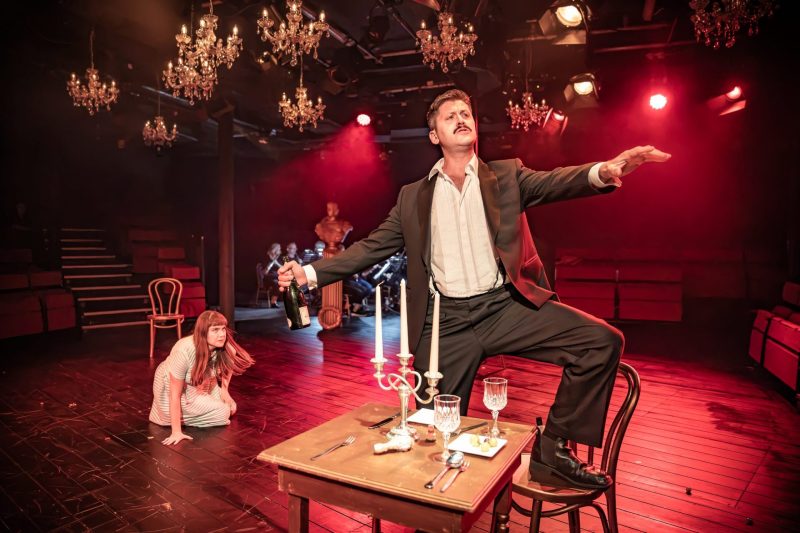
This season’s choice, a revival of their memorable production of Don Giovanni, gives the director/designer more room in which to operate, but faced with the same problems of setting the story in the round. Well, perhaps not strictly speaking completely in the round, as it has Johnathan Lyness lustily singing every note with the vocalists as well as playing the continuo, and conducting the beautifully balanced ten piece orchestra, filling one segment of the circle.
While making masterly use of six dining room chairs (the only stage dressing) to manoeuvre his cast, Richard Studer is less successful and showing when and where the moves of scene take place. This is a small price to pay for movement which looks as natural as if the cast were changing position on a stroll through the nearby North Street Bedminster looking in shop windows. No member of the audience was left for any length of time looking at, and listening too, someone’s back.
Samuel Pantcheff made such a good job of creating the despicable, murdering womaniser Don Giovanni that there were quiet a few boos among the applause as he took his final bow. Lit to perfection by Thomas Pitchers, he changed from suave lady-killing to defiant raging against heaven as he was dragged off to hell by Edwin Kaye’s fearful ghost of Il Commendatore. The gravitas that Kaye brought to Donna Anna’s murdered father helped to create a an atmosphere that bridged the move from frivolity to high drama.
Both Nazen Fikret and Robert Forrest as the high society on and off couple Donna Anna and Don Ottovio, and peasants Masetto and Zerlina, Felix Kemp and Kirsty McLean had to perform verbal and vocal gymnastics as they continually manipulated by Don Giovanni, and changed mental horses with the alacrity of a circus rider.To an even greater extent Melissa Gregory was faced with, and succeeded, in convincing the audience that she was so besotted by the charming Don Giovanni that he could continually convince her that he loved her.
Watching over all these machinations, one minute the loyal bribable servant, the next a craving tell-all coward, but always a shrewd manipulator of situations for his own benefit, is Don Giovanni’s personal servant Leporello. Sung with authority, a wicked sense of fun, and ability to change the atmosphere to believable drama, Emyr Wyn Jones, while never attempting to upstage other singers, was always a strong presence in every scene in which he was involved.
Unfortunately, this wonderfully inventive production, which remains at the Tobacco Factory Theatres until Saturday 3rd October and is playing to virtually full houses, has yet to attract the younger generation| in numbers. With its clever mixture of fun and drama this version of a true classic opera would be a good place for an experienced opera fan to introduce a young person to Grand Opera.
GRP