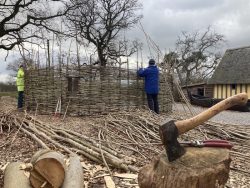
 AVALON Archaeology, at the Avalon Marshes Centre on Shapwick Road, Westhay, has completed the construction of a replica Iron Age roundhouse, which will be officially opened on Saturday 21st March, by Charlie Taylor from BBC Radio Somerset.
Visitors will be able to explore the building and learn more about Somerset’s prehistory with themed activities taking place. The reconstruction is based on evidence from the Glastonbury Lake Village, where Iron Age communities built homes and canoes to thrive in the flooded environment of the Somerset Levels.
Glastonbury Lake Village was occupied for about 150 years at the end of the Iron Age, with a maximum of 20 houses at any one time. It could only be reached by water. Built on wet peat, these waterlogged conditions has allowed the remarkable preservation of wooden structures and objects that do not normally survive, making it the best-preserved Iron Age settlement yet discovered in the UK.
A team of experimental archaeologists at the South West Heritage Trust have worked alongside volunteers to complete the project over 12 months. Members of the public also contributed to the interior decoration at a prehistoric painting workshop. The building also features an authentic bread oven.
Dr Richard Brunning, an archaeologist with South West Heritage Trust, who led the project, says: “The roundhouse is built with very small roundwood and relies on its woven structure to give it strength, rather like a large upturned basket. The walls are covered in daub, a mixture of clay subsoil, hay and a little horse poo. It is thatched with reed and has a clay floor, central hearth and small bread oven. The walls are decorated with impressions of ammonite shells and painted with natural earth colours using milk curds as a binding agent. The patterns are taken from pottery designs from Glastonbury Lake Village.”
On Saturday 21st and Sunday 22nd March visitors can enjoy themed activities that explore prehistoric Somerset, showcasing the skills and technologies that shaped daily life on the Somerset Levels. They include a chance to recreate part of the Sweet Track using neolithic tools. Visitors will also see ancient woodwork demonstrations and a reconstruction of a dugout canoe.
“This new structure helps bring to life how ancient communities built, travelled and lived within the landscape of the Levels,” says Dr Brunning. “We hope visitors gain a vivid sense of early society through the reconstructed domestic architecture, alongside the seasonal rituals and traditional crafts on offer.”
Avalon Archaeology is open every Sunday, 10am to 4pm, and Saturdays during the school holidays. For more information, visit avalonarchaeology.org.uk
Pictured is an early stage in the roundhouse construction.