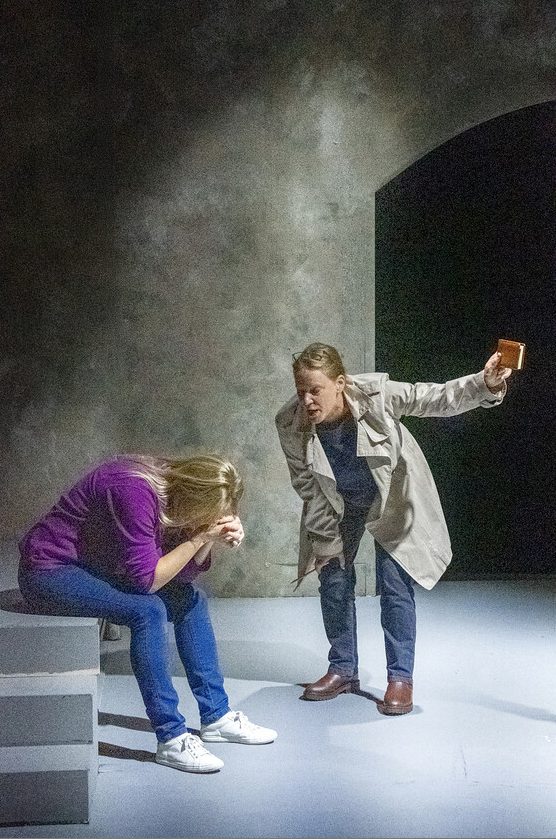
 IF you travel by train in an urban area you can see into people’s back gardens, terraces, even kitchens, get a fleeting glimpse of their lives and perhaps occasionally imagine something about them. Rachel travels by the same train into London every day for work; while the train is running at a slower speed she sees the same houses, the same people, day after day. And one day she sees a couple embracing on a terrace.
But Rachel is a mess with a memory that is not only unreliable, it is actually full of what she calls “black holes” – so when a woman (whom she doesn’t know), living a few streets away, goes missing, she begins to construct a whole story around the glimpsed lovers and the missing woman.
So far, so familiar – Paula Hawkins’ The Girl on The Train was a best-selling book both sides of the Atlantic, a box office hit starring Emily Blunt, and a play that does the rounds frequently in professional productions as well as attracting adventurous and talented amateur groups – like Salisbury’s Studio Theatre, who are staging a production, directed by Anthony von Roretz, on until Saturday 10th October.
I should admit that I don’t much like the play but I have come to recognise that part of its hold over audiences is the subtle, incremental way the story is constructed – a mirror of the structure of coercive control that has reduced Rachel (Sarah Derry) to the messed-up, alcoholic basket-case we meet in the opening scene. And the more you see the play, the more you spot the signs – anyone who remembers the famously slowly unravelling coercive control story-line in The Archers will understand this.
And on that basis, despite its flaws, this production does work – like the two audience members behind me at the interval, you don’t understand what is going on. You rapidly lose patience with the needy Rachel, swigging vodka from her water bottle, and you sympathise with the people whose paths she crosses, from her ex-husband and his new wife and the worried and bewildered husband of the missing woman to the police. You have a lot of sympathy with the detective who is trying to make sense of the baffling disappearance.
The casting of the excellent and experienced Samantha Luckman as DI Gaskill is one of the successes of this staging. It changes the dynamic with Rachel and it removes that rather uncomfortable sexual/emotional charge that is often felt between the (male) detective and the woman who is looking like the main suspect. This Gaskill has been around the emotional block a few times and has an unwilling but instinctive sympathy with the chaotic woman she has come to interview.
As Studio’s production manager Jill Redston says in her programme notes, The Girl on The Train requires “amazing sound and lighting effects” and the theatre’s back-stage crew really deliver these, particularly with the lighting changes and the use of video – including the passing trains (although there are perhaps a few too many – we do get the picture!)
The performance I saw was slow to get going – it is sure to tighten and speed up as the run continues – but it builds towards the denouement and the shocking revelations. The central performances from Sarah Derry and Samantha Luckman ensure your attention is held. Terry D’Onofrio is Rachel’s ex-husband Tom, Emily Casselton is the neurotic second wife Anna, Antonia Harding plays the missing gallery owner Megan, Jacob Franks is her understandably confused and worried husband Scott, Matt Hodge is the ambiguous psychiatrist and Sophie Cuerden is the police constable and a secretary.
Photograph © Trinity Photography
FC