 THE Marquise is a very unusual Noel Coward play, written in 1927 as a star vehicle for his friend, the singer and actress Marie Tempest, but set in 1735. Bookended by his smash hits Hay Fever and Private Lives, it is rarely performed, perhaps because it lacks the welter of wit and bon mots of which Coward was becoming The Master.
The current touring production, directed by Philip Wilson, brings the action forward into 1930s France, giving Colin Falconer free rein to create a beautiful Art Deco set for the grand country home of Raoul de Vriaac. As the curtain rises, the dictatorial, grumpy and humourless Raoul is setting out his plans for his daughter’s wedding to the son of his oldest friend, Esteban. Whether Adrienne and Miguel want to be married is irrelevant.
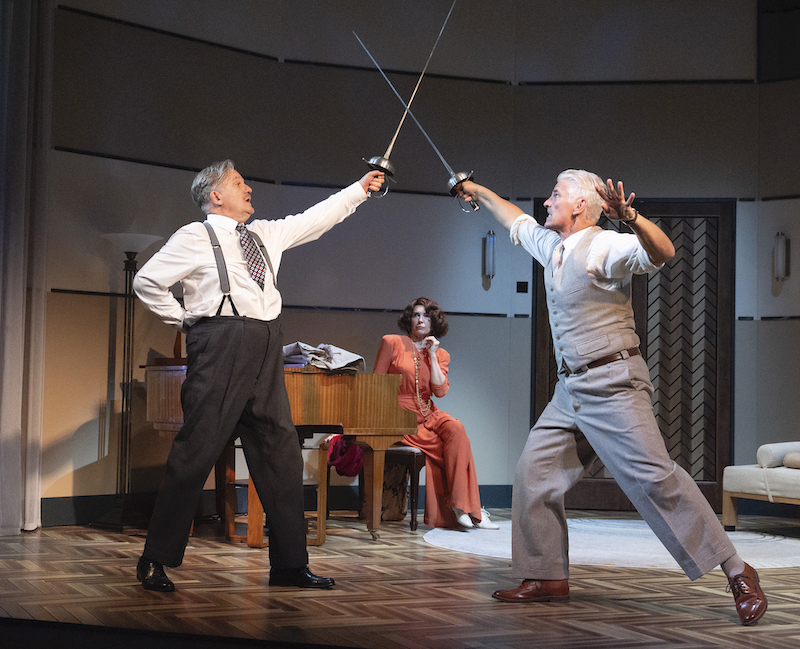 Esteban tries, unsuccessfully, to persuade his old and one-time lively companion-in-fun to lighten up a bit. Adrienne loves her father’s secretary Jacques, and Miguel has his own secret love, but Raoul, a widower who keeps his sainted late wife’s confessor close by, is having none of it.
Into the mix, and via the floor-to-ceiling windows, comes a distraught woman. A wheel has come off her Bugatti, and she’s stranded with nowhere to go. Can she stay the night. “No”, says Raoul. “Yes”, says the horrified Adrienne. And thus the story unfolds, forcing the two old friends to confront the long-hidden realities of their past lives.
Coward navigates the twists and turns with his usual style and panache, putting La Marquise Eloise de  Kestournel at the centre of the action – for it is she with the broken (or not so broken) Bugatti. Juliet Aubrey brings her subtle skills to the role, creating a sensationally elegant, beautifully dressed and highly theatrical woman whose long-planned attempt to remodel her life is all but scuppered by co-incidence. But The Marquise is a clever woman, well able to manipulate the egos of two middle-aged men to her advantage. She is, and always has been, very much in charge.
The play manages to be touching and funny, providing moments of Cowardian archness and painful poignancy. There is even a duel, a highlight of the evening as irascible and sanctimonious Simon Shepherd and smooth, suave Tristan Gemmill face each other across the magnificent drawing room, rapiers drawn.
You could call it old fashioned (it evoked commendably few modern whoops from the delighted audience) but it is stylish, funny, clever and – if not classic Coward – an interesting glimpse into the timelessness of men’s competitive natures, and how easily they can be played.
GP-W