 WHEN a novel is adapted for the stage, then a TV film and finally for the big screen, there are bound to be arguments about which format the story is best told in. Having seen them all, and with the support of most of those who have all seen or read the story in all its guises, I have no hesitation in saying that Stephen Mallatratt’s stage adaptation is by far the best version of Susan Hill’s gothic horror story.
The reason is that, even more than the novel, it plays on your imagination. Anyone who can remember those moments of terror when, as a small child left in the dark, you imagined the room being full of ‘ghoulies and ghosties and long-leggedy beasties, and things that go bump in the night’, will know how powerful the imagination is at conjuring up far greater terrors than any picture could.
 On the face of it, the play has no right to succeed. You have two men on a virtually empty stage – solicitor Arthur Kipps wants his memoirs of a horrific youthful experience, when he was sent to the isolated Eel Marsh House, situated at the end of a causeway only accessible at low tide, to sort out the papers of the late recluse Mrs Drablow, presented on stage for friends and family. He has employed an actor to arrange the story so that it is fit for a public performance.
But under the watchful eye of original director Robin Herford, making wonderful use of Michael Holt’s bleak setting and the lighting and sound designs of Kevin Sleep, the horrors of what happened in and around Eel Marsh House, and the effect, real or imaginary, that seeing the mysterious “woman in black” has had on the local population and will have on Arthur Kipps, are vividly brought to life.
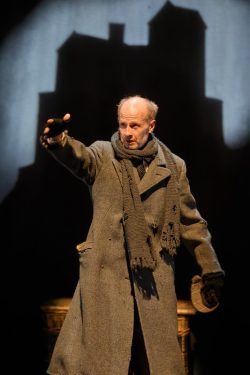 John Mackay makes his Arthur Kipps a lovely, diffident character to start with, and then under the tutelage of the Actor, Daniel Burke, blossoms in confidence as he portrays all the characters his young self met on his visit to Eel Marsh House. Daniel, who takes over the character of Kipps as they rehearse the story, moves from overconfident young London solicitor to quivering mental jelly after encounters with the mysterious woman in black.
Is she real or just a figment of Kipps’ imagination; was she really the cause of the tragedies that had befallen local inhabitants and would have a disastrous effect on Kipps’ future life? Or like the audience, are they conjuring up horror and terror in their minds rather than reality?
Thanks to the sound and lighting and the two players’ ability to mime, one props basket and a couple of chairs are all that is needed to take us on a journey by train from London to the small north-eastern town, and across the causeway in a pony and trap. The horror, 30 years before, of the panicking horse and trap, and passengers caught in quicksand as a sea fret swept in, is frighteningly brought to life.
Anyone with a nervous disposition should remember that the final line of the “ghoulies and ghosties” verse is “good Lord, deliver us”.
If you miss The Women in Black in Bath you can catch up with it at the Lighthouse arts centre at Poole from 17th to 21st February 2026 or Southampton’s Mayflower Theatre between 7th and 11th April.
GRP
Photographs by Mark Douet